Huge Radio Survey Reveals Millions of Cosmic Objects Across the Universe
- DEREK MCDERMOTT
- Feb 28
- 2 min read

Astronomers conducting the largest radio survey ever have catalogued 13.7 million cosmic sources, including black holes, supernovae, and colliding galaxies. The unprecedented dataset provides a detailed map of the universe’s dynamic radio sky, opening new opportunities for discovery.
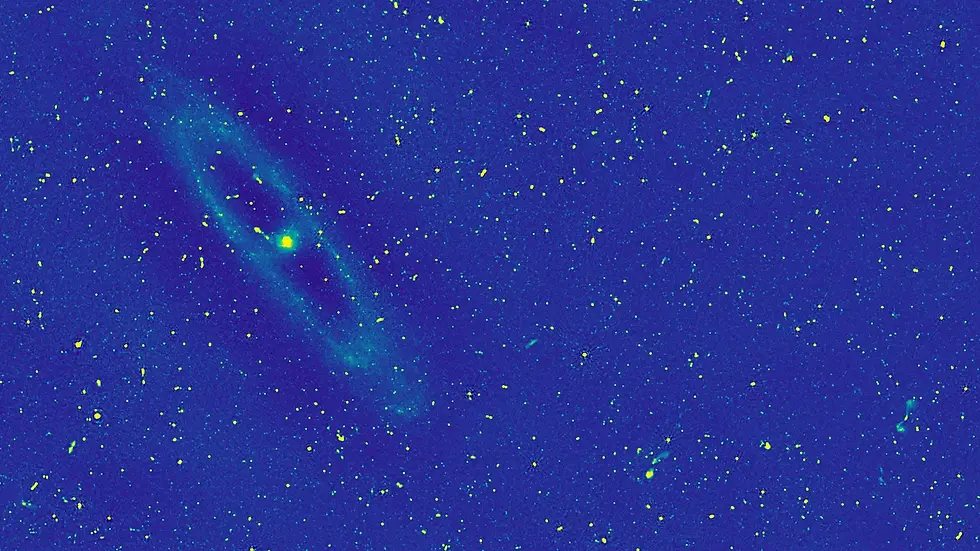
Andromeda Galaxy M31 as seen in radio waves - Credit LOFAR surveys collaboration
Mapping the Radio Universe

The survey, which covers billions of light-years of space, detects active galactic nuclei, star-forming galaxies, and transient events such as supernovae. Using cutting-edge radio telescopes, astronomers can now study the structure and evolution of the universe in greater detail than ever before. This comprehensive map allows scientists to understand how galaxies form, grow, and interact over cosmic time.
Insights into Cosmic Phenomena

By analyzing millions of radio sources, researchers can identify rare phenomena including merging black holes, exploding stars, and fast radio bursts. These discoveries provide clues about extreme environments and fundamental physics that are otherwise invisible in optical or infrared surveys. Understanding the distribution and behavior of these cosmic objects helps scientists refine models of galaxy evolution and the large-scale structure of the universe.
Implications for Future Research

The dataset serves as a foundation for follow-up observations across multiple wavelengths, enabling astronomers to cross-check data and uncover hidden details. Future studies will use this map to investigate star formation rates, galaxy collisions, and the role of dark matter in shaping cosmic structures. The survey also provides a critical reference for upcoming space missions and radio observatories seeking to study the dynamic universe in unprecedented depth.
Global Collaboration and Public Access

The radio survey was conducted by an international team of astronomers, with data made publicly available for scientists worldwide. Open access to this large dataset encourages collaboration, accelerates discoveries, and ensures that new findings are rapidly shared across the global scientific community.
The Next Frontier
As the survey continues to expand and refine its catalog, astronomers anticipate discovering millions more transient and permanent cosmic objects, further enhancing understanding of the universe. This ambitious project represents a major milestone in mapping the cosmos and sets the stage for decades of research into its most energetic and mysterious phenomena.


Comments